Oktoberfest is an over two-hundred year tradition that is celebrated in Munich, Germany. Every year, from late September to early October, around seven million people flock to the festival to celebrate culture and to have a good time. To put that in perspective, about one million people visit the Iowa state fair every year! At Oktoberfest, there are plenty of festivities, including a ferris wheel, games, beer and traditional Bavarian dishes. Some of these delicious meals are familiar to us here in Iowa, including Sauerkraut, Wiener Schnitzel and Bratwurst.
Oktoberfest today is a very bright and joyous celebration, but it didn’t always start out this way. Its origins began on October 12, 1810, the wedding day of Prince Ludwig and Princess Therese. Munich officials invited the townspeople to celebrate on the fields outside the city walls. The first event that Oktoberfest featured, other than the wedding, was a horse race. This event was bursting with the energy of 40,000 spectators, and closed with a children’s choir.
Since that first opening festival, Oktoberfest has developed in a number of ways. Carnival booths were added, selling jewelry, porcelain and silverware as prizes. In 1850, a parade which featured citizens in traditional German attire was included, and remains even today. In 1880, electric lights were added to all the booths, and in the following years, Bratwurst and beer stalls added to the excitement. During World War 1, Oktoberfest was canceled, and again during the hyperinflation of the 1920s. From 1933 to 1945, the Nazi party used the festival for propaganda, and suspended it during World War 2. Now, in the 21st century, the festival hosts a museum tent and costumed horse races, and the population has increased substantially.
Backtracking to the 19th century, there were many immigrants from Germany who brought the Oktoberfest tradition to Iowa and South Dakota, where we celebrate it even today. Iowa State University wrote an article about German immigration stating, “German immigrants are the second largest immigrant group to settle in Iowa, second only to people from the British Isles. Immigrants from Germany began settling in every Iowa county in the 1840s, making them the largest-spread immigrant group in the state. They influenced politics, were economically and financially secure, and brought traditions, such as gymnastics and beer, to the state.” However, it hasn’t always been smooth sailing for Germans in Iowa. During the World Wars, Germans were discriminated against. German books were burned in public, people would be harassed, businesses were attacked and German-named towns were coerced into changing the name. Because of this, many German-Americans decided to embrace their Americanness, especially in light of the tragedies of World War 2.
While German immigrants have had to endure some difficult circumstances, the tradition is still alive and well. In modern day, breweries across South Dakota and Iowa still celebrate the beloved Oktoberfest. The Siouxland is especially alive with festivities this time of year, with mini events featuring the ever-present games beer, and food.
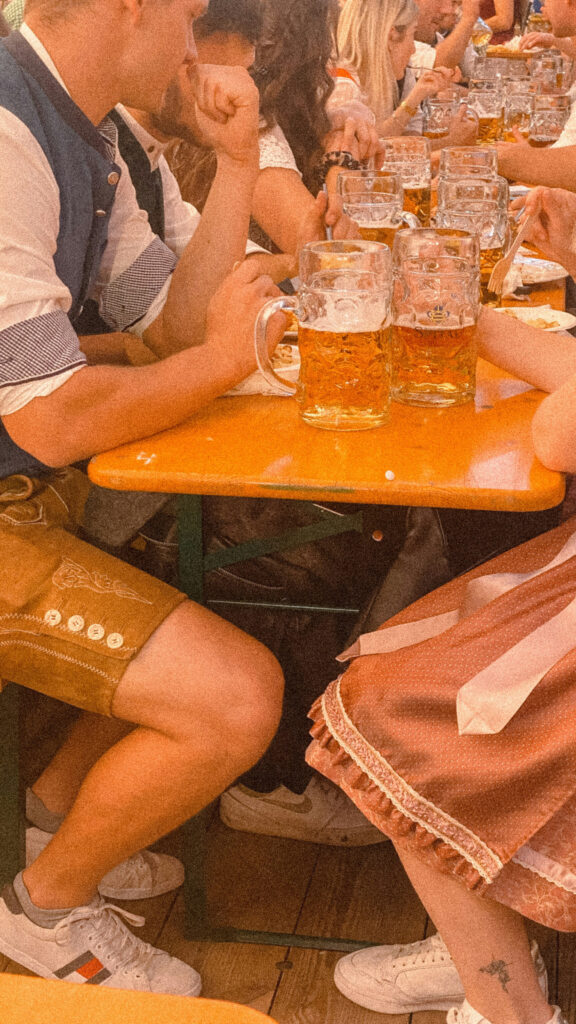
Festive people drinking beer at Oktoberfest.