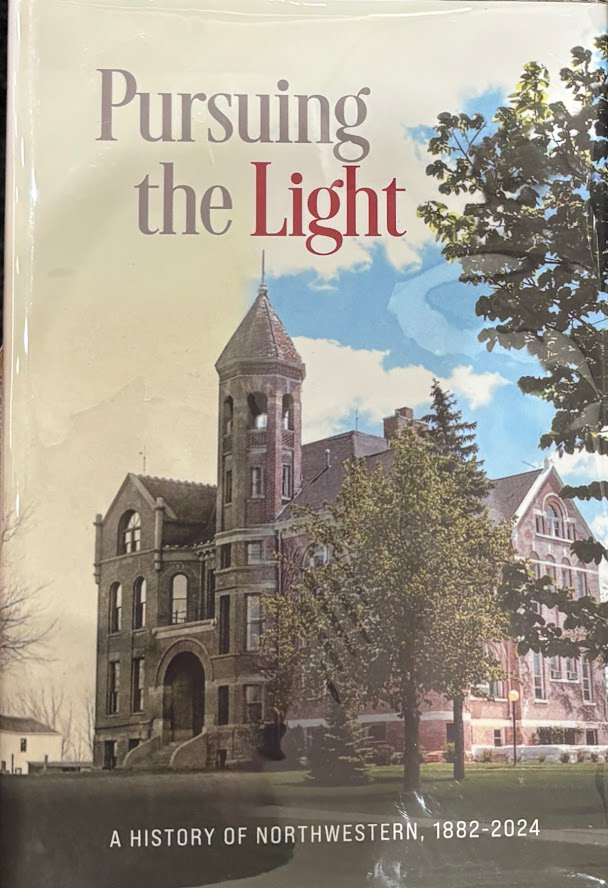
A new piece of literature has come to Northwestern College. Pursuing the Light: A History of Northwestern, 1882 discusses NW, all the way from its founding in 1882 through the 2024 school year. The text outlines NW’s early years, its transition to a junior college and then later into a 4 year college, as well as the addition of graduate programs (such as MBA, M.Ed., and PA). The nine chapter book is arranged chronologically, divided into key periods at the school. Most chapters culminate with a special section on athletics in order to highlight developments in that section of the college. In addition to the main text, there are over 40 sidebar articles highlighting people, events and popular topics at NW. At the end of the book, there are appendices sharing reference materials such as enrollment figures, brief building histories, a list of theatrical productions and head athletic coaches.
The book was created in order to have a fresh history book of the college. Dr. Gerald DeJong had previously written a book on NW history titled From Strength to Strength, which covered the first 100 years of the college (1882-1982). As we approach the 150th anniversary of NW, President Gregory Christy requested that we summarize the institution’s history again with the addition of recent years.
The number of students enrolled at NW has skyrocketed as the college enrolls about 1,700 undergraduate and graduate students each year, and has more than 16,300 alumni around the world. The synopsis of the book writes, “As in the past, Northwestern looks to the future with confidence and faith that God’s light will continue to shine”.
At the back of the book, Dr. Douglas Anderson, the primary author, says “Spaces become places as people grow mindful of them…This book is about minding the history of Northwestern College, a place with a lengthening past.”
Anderson spent more than eight years researching the volume. The title of the book is a nod to NW longtime motto, “Deus est lux (God is Light)”. When Anderson was asked about the title in the recent press release, he said, “Hopefully readers will see that God has been at work at Northwestern and that we’re seeking God’s light. We don’t claim to have always found it, but we are pursuing it.”
When asked about the writing process, Anderson described it as long and often complicated. The most difficult material was the history for the 21st century, as they had to deal with “the present” more than “the past”. Anderson has been working on this book for more than eight years, with all the research and writing that had to be done.
“The book is intended to help readers get some understanding of how Northwestern came to be and what it is now – a narrative overview which can also serve as a reference when one has questions about Northwestern’s past.” Anderson said.
The writing process of this book was taken on by a large group of people besides Anderson, the primary author. The sections of athletics were written by Duane Beeson, Director of Marketing and Communications. The sidebars were written by a collection of authors including Carrie Odell Anderson, Beeson, Greta Grond, Jill Haarsma, Sara Huyser, Emelie Laackmann, Dr. Rebecca Koerselman and Kim Van Es. The content and copy editing was done by Van Es. Haarsma also served as the managing editor.
Grond compiled the appendices and photos, and when asked what she took away from the process, she stated, “I’m honored to have been part of the team that created this book. I learned so much about the institution I serve, and I loved digging into the archives to learn about the people and events that shaped our school. Doug Anderson and Duane Beeson are terrific writers, bringing life and color into this history.”
This book came out last fall, and the sales report has been slow. Despite the slow demand, Anderson hopes that this article will help sales since it will help provide more information to students. Copies of this wonderful, insightful book are still available and can be purchased at the NW bookstore for $25. All proceeds go to the archives, which help NW continue to preserve its history.