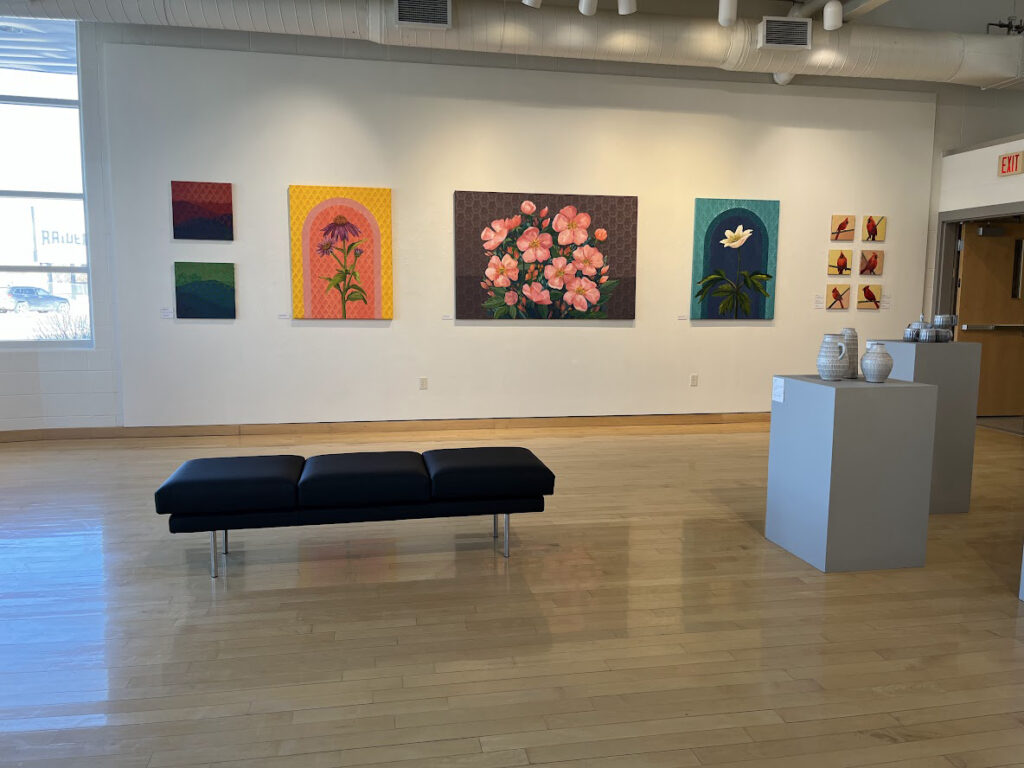
“Grounded,” the current exhibition at NW’s Te Paske Gallery in the Korver Visual Arts Center, jointly showcases the work of ceramist Danielle Whigham and oil painter Emily McQueen. Though the artistic media is different, the pieces maintain a sense of visual unity.
Whigham, an alumnus of NW, explains in her artist statement “My work is created to be simple yet enticing to the viewer – inviting them to hold and use.” Each of her ceramic pieces is both a meaningful work of art and a functional object for practical use.
Emily McQueen uses hand-carved block prints coupled with oil paint to create pieces that are simultaneously geometric and organic. She states that “the predictable repetition of the print contrasts with the singular, expressive nature of the paint…[and] reflect[s] the human struggle to find individual meaning within the broader, often indifferent cycles of the natural world.”
Both artists reside in the Glenwood area, and the artwork featured in the gallery will be available for purchase after the exhibit ends.
“Grounded” opened to the public on Jan. 13 and will be on display through Feb. 26. The opening reception was held at 6:30 p.m. on Jan. 13, and was attended by a handful of students, several faculty members, and the artists themselves. Receptions like this are held for each of the art exhibits that are featured in the Te Paske Gallery every few months. They provide a unique opportunity for students and other attendees to hear the artists speak about the thoughts and creative processes behind their work and to ask them questions. This can be especially inspiring for student artists but also enables anyone to develop a deeper appreciation toward the artwork in the gallery. As part of her introduction speech at the reception for “Grounded,” Professor Amy Williams encouraged students to look for the connections between the paintings and the ceramic vessels because the gallery had been strategically arranged for that purpose.
Whigham and McQueen both draw on nature themes in their respective work, but the connections often go beyond that. Whigham’s “Sediment and Sky” has a stylized motif of layered rolling hills on the lower part of the vessel body. Stripe patterns add texture, variety, and depth to the scene. The backdrop for this piece is McQueen’s “Prairie Pattern” and “Anemone Nemorosa,” both of which feature layered rolling hills and an element of pattern. Similarly, McQueen’s “Gentle Slope,” with its pronounced vertical lines, hangs on the wall behind Whigham’s “Grey-Blue Teapot Set,” which also sports pronounced vertical lines. The gallery is full of these comparisons, and it makes for interesting discussion while viewing.