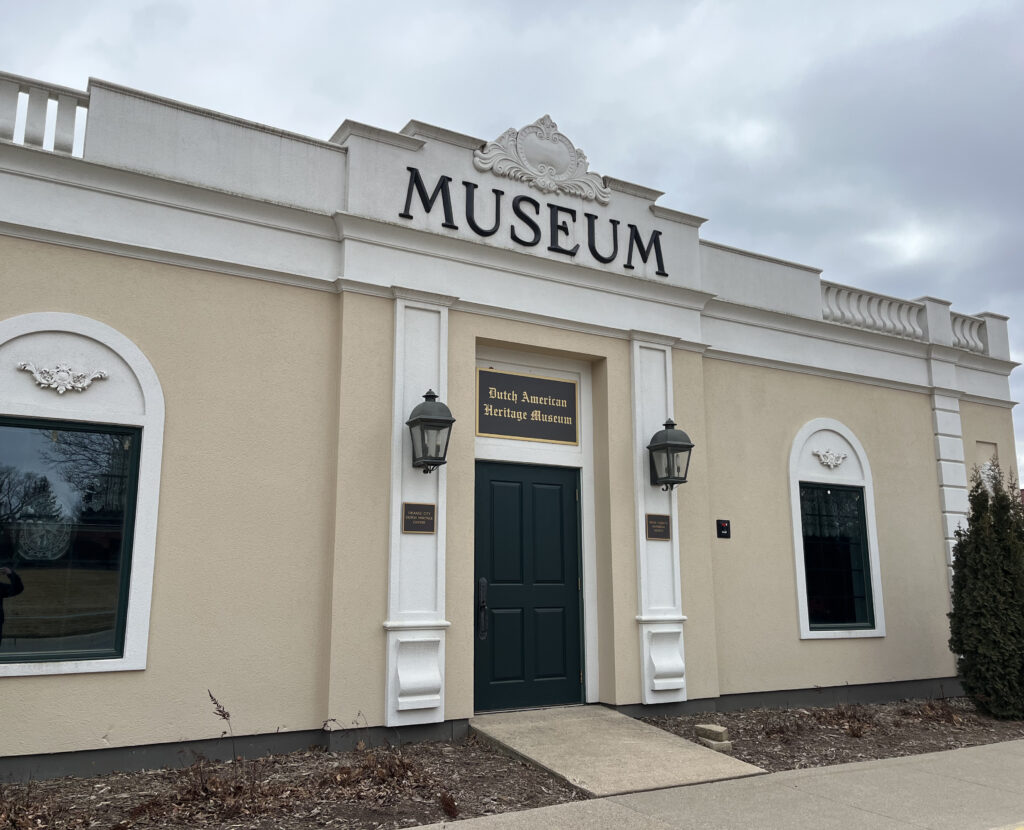
The Dutch Heritage Museum is home to many OC artifacts.
Orange City was founded in 1870, when Dutch settlers came up from another small Dutch town, Pella, IA with the vision to build a new and thriving community based on dreams, and to expand agriculture. This group was led by Henry Hospers, and Orange City has become a thriving tight-knit community.
One of the many ways to learn more about the history and to be able to see relics is to visit the Dutch Heritage Museum. This museum is located uptown in the small town, right across the street from the courthouse. The mission of this history establishment is to preserve the stories of northwest Iowa. It was first founded in 1969 and was located in a house by Dutchmart Food Center. It was later updated in the 1990s.
The museum is run by volunteers, and is able to be visited as it stands today after a fundraiser during Covid that gave the museum an updated second building, and a garden that was part of the capital campaign.
“Stories about real people make it more real, and help people understand history making it more relevant for people to study,” said museum volunteer, Sarah Huyser.
The museum is made up of three different buildings including the main museum, which has Dutch and Native American artifacts, the military annex held in a smaller building and an old schoolhouse.
As they walk through the Dutch heritage sections, visitors are able to see a little bit of everything that the Dutch have to offer.
The first section has clothing, both authentic and modern renderings, which is part of the immigration to America story and a small gift shop with trinkets made by the volunteers. The second section tells about how settlers came from Pella to Sioux County. One artifact that is really interesting in this section is a corn stalk from 1872, making it 154 years old.
One of the events held in this section of the museum that occurs during the winter is “Books at the Museum”. For this event, readers will come in and tell stories from Orange City history, such as the Children’s Blizzard of 1888 which was told last week at the event. The museum also works at making walking around fun for kids, by planning activities such as the “Where’s Henry? Hunt”. For this activity there are nine small photos of Henry Hospers, sporting some stand out sunglasses, around the museum. If a kid finds at least eight, they receive a piece of candy. According to Huyser, this makes it possible for the kids to be interested enough to allow their parents and other adults to take the walk through the museum at a slower pace.
The third section shows more artifacts, such as a prohibition still and a wall with writings about the tragedies that have befallen the community, since that is a part of the history that should not be forgotten. There are also artifacts from family homes of the past, used on farms. Huyser’s favorite is the dog treadmill, a contraption in which one would hook up the dog, and as the dog ran, a mechanism would spin and cause laundry to run. The dogs subjected to this tool were not too fond of the contraption, causing them to often run and hide. The people of the time would then try goats which also didn’t work resulting in little boys being hooked up to run the machine.
One of the newest parts of this section is the wedding dresses that they have on display, depicting bridal styles from 1889 to 1991. One of the most memorable parts about these dresses was how small they are, especially when compared to dress sizes today. Huyser’s dress is one of the dresses on display, and next year the collection is to add a pink dress and a black gothic one. The third section finishes with an entertainment portion, depicting what people had for books, music, sports, leisure and photoshop, such as a train being hoisted in the air by a hot air balloon.
The final section in the main building is the Native American exhibit, in order to remember those who lived on the land before. Most of the items were donated by The Vogel Foundation which has many pieces to establish the Native American history in the area.
The second building, the military annex, shows history from the Civil War, World War I, World War II, the Vietnam War and the Korean War. Although Orange City was not established at the time of the Civil War, they still honor the Pella soldiers who fought in it. The back of this building is left blank to hold the hope for no new large conflicts. One special point of interest in this building is a pot warmer that was donated by Randy Van Peursem. When Van Peursem visited the Netherlands, he was able to reconnect with a family friend who he has stayed connected with for 40 years, and they gifted this item to him that he donated to the museum.
“It was really interesting how the Dutch came here to the Orange City area. I like how, when we were going through the museum, it was like a story of how people lived through the different aspects of their lives.” Said NW freshman Austin Lavender “It was really fun to go there and see what all they had for us to learn more about the history of Orange City, and I can’t wait to learn more.”
The Dutch Heritage Museum is open full-time during the Tulip Festival in May, as well as throughout the year by appointment every third Thursday of the month through email or Facebook Messenger. Admission costs are $5 for adults, $1 for youth (6-18) and children ages 5 and under get in free.
According to their brochure, “The museum regularly conducts guided tours for elementary, middle-school, high-school, and college classes. We also provide guided tours for family reunions or small groups.”
At the current time, they are working with a NW alum who is helping the volunteers put everything into catalogs and are looking to hire a part-time staff member to help with scheduling more often.