NW has had a long history of theatre. The first ever recorded production was titled “The Gold Bug” and was put on in early 1923 by the school’s senior class, back when NW was called “Northwestern College Academy”. When NW added a Junior College alongside the Academy in 1928, the two schools would alternate productions for the time being until something bigger was added. This began with Dr. Theora England, a very important professor in the growth of NW theatre department. She was hired in 1942 to teach latin and math at the Academy. That same year, Dr. England directed the senior show at the academy. After that, the theatre continued to grow under her direction.
Dr. England added a second official theatre class in 1950 as she was moved to the speech department just a year before. Nine years later, she formed the Choral Readers, which is now known as Drama Ministries Ensemble. They would travel and perform for churches and a few other audiences. She is also credited with the creation of many foundational theatre classes and the annual children’s show. A speech major was established in 1962 during her time at NW as well.
The theatre department’s first official “playing” space was in NW’s multi-purpose auditorium in 1957. The first production produced there was “Anastasia” which was directed by Dr. England. However, the department found it hard to hold rehearsals as the auditorium was not only the theatre’s, but rather a space for multiple activities. Even so, between the years of 1957 and 1970, many plays were produced in the auditorium including “The Glass Menagerie”, “Tea House of the August Moon”, and “Rumpelstiltskin”, all directed by Dr. England.
After the auditorium came “The Playhouse”, which was the old American Reformed Church that was renovated to become a theatre. With leaky ceilings, unsafe catwalks, and crashing sets, this was the theatre department’s home for the next 43 years. Some of the plays produced here include “The Taming of the Shrew”, directed by Dr. Steve Pederson, “The Dining Room”, directed by Karen Barker, and “I Believe in Make Believe”, directed by Dr. R. Keith Allen.
Shortly before “The Playhouse” was acquired, Dr. R. Keith Allen was hired. He took over as chair of the department when Dr. England retired and designed sets and lights for many of the productions. He was also the technical director. During Dr. Allen’s time, NW officially became a four-year liberal arts college and then later established a theatre major in 1977. He brought much knowledge and was known well for his work, specifically with the children’s shows.
In 1988, Karen and Jeff Barker arrived at NW. They spent a lot of time building up the department through the ensemble approach and the importance of creating “Kingdom Art”. DME was an important group to them, and they helped shape it to what it is today. Perhaps what is most known today is the theatre department’s motto, “To the King. To the Restoratio.n”, which Karen and Jeff Barker brought into the theatre.
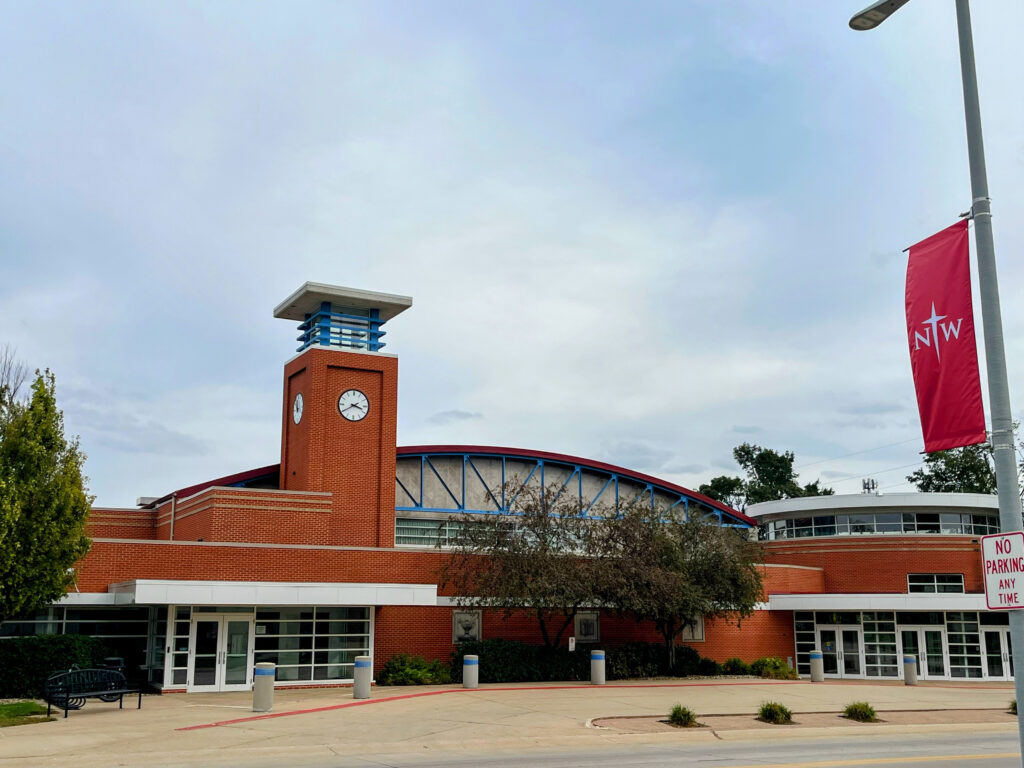
Finally, NW’s Theatre Department was given a proper home in the DeWitt Theatre Arts Center in 2003. The old auditorium was renovated to meet the needs of a growing department. They were given not only one theatre, but two theatres, in this new building, which are named after Dr. England and Dr. Allen. This new building also has a costume shop, a scene shop and an office space. The new space has been loved and cared for well by all the students and faculty who have come and gone in the past years. Shows produced here include “The Comedy of Errors”, directed by Jeff Barker, “The Lion, the Witch, and the Wardrobe”, directed by April Hubbard, and “Little Shop of Horrors”, directed by Megan Weidner.
NW now has a nationally recognized theatre department that can well equip students with the knowledge and skills to go out into the world as Kingdom Artists. The walls in the upstairs hallways are filled with the history of productions, buildings and professors who contributed to the creation of how this department came to be. Each piece of history is equally important and will continue to be a part of the shaping of the theatre today.